01
How do these sensors work?
Review microlens arrays, spot displacement, centroiding and wavefront reconstruction.
Explore the measurement principle, compare publicly documented commercial sensors and discover where their capabilities can support real applications.
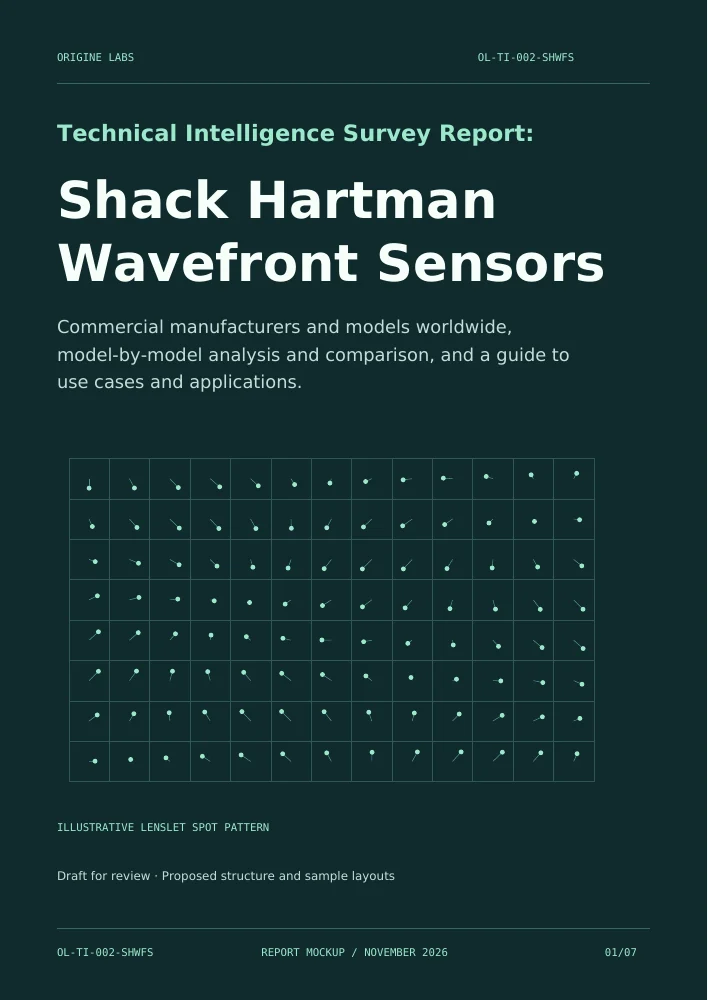
Shack–Hartmann wavefront sensor technologies, commercial manufacturers and models, comparison criteria and applications.
Wavefront sensing · Microlens arrays · Spot centroiding · Optical metrology · Astronomy · Adaptive optics
What is this report?
This planned survey brings together the fundamentals of Shack–Hartmann sensing with a structured overview of publicly documented commercial manufacturers and models. It aims to help engineers and researchers understand the options, compare reported specifications and identify sensors suited to their applications.
The report will distinguish published manufacturer claims from analysis and highlight missing information, measurement conditions and differences in how specifications are reported.
Questions addressed
Review microlens arrays, spot displacement, centroiding and wavefront reconstruction.
Explore manufacturers, product families and publicly documented models.
Examine detector dimensions, subaperture matrices, wavelength coverage and reported acquisition or measurement rates.
Consider sensitivity, dynamic range, accuracy, sampling, interfaces and measurement conditions.
Map capabilities to astronomy, optical testing, laser characterization, microscopy and adaptive optics.
Identify unavailable specifications, vendor-dependent definitions and questions for suppliers.
Who should read this report
Planned coverage, based on public sources and engineering analysis.
Planned report coverage
Operating principles, optical architectures, detectors, calibration and reconstruction.
A structured landscape of publicly available products, suppliers and product families.
Model-by-model comparison with source attribution, metric definitions and limitations.
A map of relevant applications and the sensor capabilities they may require.
Optical compatibility, speed, spatial sampling, sensitivity, software and integration.
Public sources, comparison criteria, data gaps and guidance for interpreting the findings.
Interactive companion
Compare publicly reported specifications, filter models and review source links using the Origine Labs benchmark. The benchmark and report are complementary; each retains its own scope and source notes.
Open the sensor benchmark →The report is in preparation. Contact us to discuss its planned scope and receive further information when available.